
Indice
- The Foundation: Structure Before Creativity
- 1. Protein: The Structural Core
- 2. Carbohydrates: Functional Energy
- 3. Fat: Energy, Density and Absorption
- 4. Vegetables and Fiber: Quiet but Important
- 5. The Critical Layer: Micronutrient Balance
- The Most Common Mistakes in Home Cooking
- Why I Wrote The LOONAWELL Cookbook
- Supplementation in Long-Term Home Cooking
- Feeding Is Not a Trend
- Domande frequenti
There is something deeply human about wanting to cook for those we love.
When dog owners tell me they have started preparing meals at home, I understand the instinct immediately. It comes from trust, and from the desire to know exactly what goes into the bowl.
And in many ways, it is a beautiful impulse. But love alone does not make a meal complete.
Over the past six years building LOONAWELL, formulating recipes, working alongside veterinary nutritionists, and studying ingredient functionality, I have learned that home cooking for dogs is both empowering and delicate. It can support health profoundly. It can also create silent deficiencies if done incorrectly.
If you choose to home cook, do it properly. Let me show you how, so you don’t have to worry that something essential has been left out.
The Foundation: Structure Before Creativity
A well-constructed meal is not random. It follows proportions, and behind those proportions is purpose.
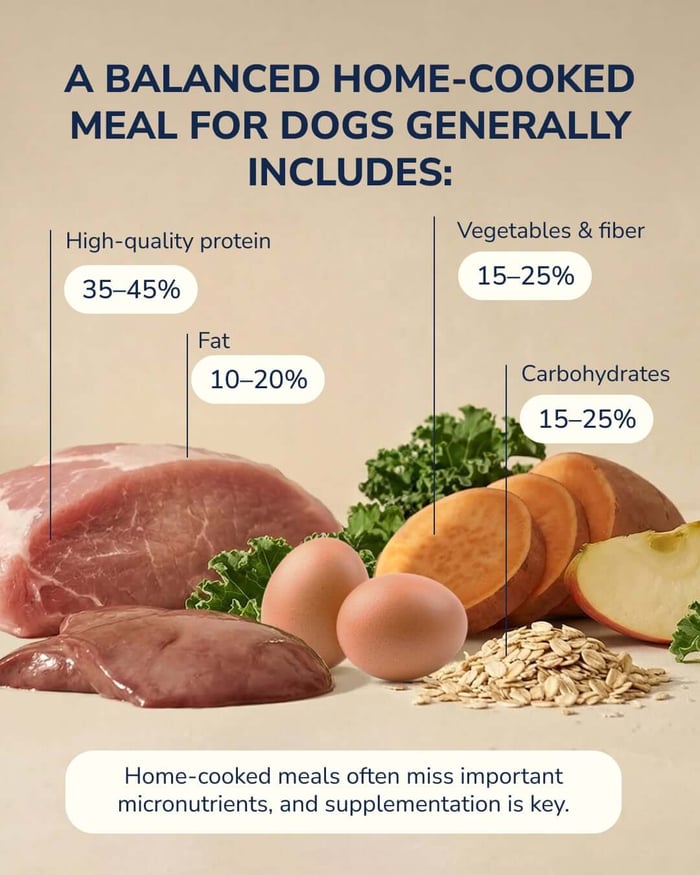
While exact needs vary depending on age, weight, and activity level, a balanced framework for an adult dog generally includes:
35–45% high-quality protein
15–25% carbohydrates
10–20% fat (naturally present within the ingredients)
15–25% vegetables and functional fiber
Essential micronutrients (non-negotiable)
Puppies in growth phase and dogs undergoing weight management may benefit from protein levels toward the upper end of the range, and in some cases moderately above it, provided total caloric intake and mineral balance are carefully controlled. In these situations, dietary fat is often reduced to adjust overall energy density while preserving lean muscle mass.
Such adjustments should always be made thoughtfully, particularly during growth.
These ranges are not rigid formulas. They provide structure and structure prevents deficiency.
Let us examine each layer:
1. Protein: The Structural Core
Protein forms the backbone of a home-cooked meal.
Most dog owners use standard cuts such as, lamb fillet, pork chops, turkey breast, beef tenderloin. These are sometimes referred to as muscle meats (to differentiate them from organ meat), and they provide the amino acids required for tissue repair, immune resilience, and metabolic function. Fish, such as salmon, cod, dorade or egli fillets are also a great source of healthy protein for your dog.
Some feeding approaches recommend including small amounts of organ meat, such as liver or kidney, because they are rich in vitamin A, copper, and B vitamins.
This is nutritionally valid. However, organ meat is not mandatory if the overall diet is properly supplemented.
If you choose to include liver, it should remain modest in proportion. It is highly concentrated nutritionally. More is not better.
If you prefer to prepare a meal with refined muscle cuts alone, which many owners do, then structured micronutrient support becomes essential to compensate for what muscle meat does not naturally provide in sufficient amounts.
You can prepare a delicious, healthy meal with fillets and chops. But balance must be intentional.
The proteins I use most for my own dogs include pork chops, lamb fillet, minced beef, salmon fillet, cod fillet, and tuna. I personally avoid chicken, as it is one of the most common allergens in dogs, and mine react poorly to it.
2. Carbohydrates: Functional Energy
Carbohydrates are often misunderstood in canine nutrition.
When chosen carefully and cooked thoroughly, they provide digestible energy, fiber, and additional micronutrients.
Suitable examples include:
Sweet potato (a favorite in our kitchen)
Brown rice
Millet
Lentils (well cooked)
Potatoes, roasted gently with rosemary and a touch of olive oil, which can complement a salmon fillet beautifully
Carbohydrates should support the protein base, not dominate it.
When selected thoughtfully and cooked properly, they serve a clear physiological purpose: they provide digestible energy, contribute soluble and insoluble fiber for gut regulation, and deliver additional micronutrients and phytonutrients that support metabolic stability.
They are not fillers when used purposefully. They are functional components of a balanced meal.
3. Fat: Energy, Density and Absorption
Fat deserves its own discussion.
When you use natural cuts such as pork chops, lamb, beef, or salmon fillets, you are already incorporating dietary fat. This is not inherently problematic, in fact, it is physiologically appropriate. Fat is an essential macronutrient for dogs. It provides:
Concentrated energy
Support for skin and coat integrity
Hormonal balance
Absorption of fat-soluble vitamins (A, D, E, K)
Dogs metabolize fat efficiently and rely on it as a significant energy source.
The goal is not to eliminate fat. The goal is proportion.
Excessively lean meals may lack caloric density and satiety, while excessively fatty meals, particularly in sedentary or sensitive dogs, may cause digestive disturbance.
When additional oils are introduced, such as omega-3 fish oil, they should be considered part of the total fat intake. Balance, not restriction, is the objective.
4. Vegetables and Fiber: Quiet but Important
Vegetables contribute more than color. They provide fiber for digestive regulation, antioxidant compounds, and phytonutrients that support cellular balance.
Examples include:
Broccoli florets (lightly cooked)
Zucchini (peeled if digestion is sensitive)
Kohlrabi
Spinach in moderation
Vegetables should be steamed or gently cooked to improve digestibility. Raw vegetables often pass through undigested and may irritate sensitive dogs.
This is particularly relevant for dogs prone to digestive fluctuations.
5. The Critical Layer: Micronutrient Balance
This is where most home-cooked diets fall short.
Muscle meat is naturally high in phosphorus but low in calcium. Without correction, this imbalance can compromise skeletal integrity over time. Calcium must be balanced carefully.
Dogs do not synthesize sufficient vitamin D from sunlight. Essential fatty acids, particularly omega-3, are not reliably present in standard meat cuts. Trace minerals such as iodine, zinc, and selenium require deliberate inclusion.
These are not optional details. They are physiological requirements.
Dogs can synthesize certain non-essential amino acids internally.
They cannot synthesize:
Essential fatty acids in adequate amounts
Vitamin D sufficiently
Calcium
Several trace minerals
These must be provided through diet, mostly through the form of supplementation, consistently and proportionally.
Precision matters more than abundance and this is precisely why we developed our three supplements, MegaLoona, Berry Bee, and FlexiLoona. When home cooking is paired with structured supplementation, it becomes complete.
The Most Common Mistakes in Home Cooking
After years of conversations with dog owners, the same patterns appear repeatedly:
Too much muscle meat
Excess liver
No calcium correction
No structured omega-3 source
Overreliance on raw vegetables
Ignoring portion adjustments based on weight and activity
Removing all visible fat out of fear
Home cooking without framework becomes improvisation. And improvisation, over time, becomes imbalance, diarrhea, dull coat, itchiness, loss of vitality.
Why I Wrote The LOONAWELL Cookbook
That is why I wrote The LOONAWELL Cookbook.
It is not a collection of occasional recipes. It is a complete framework for structured home cooking.
Inside, we outline:
The six building blocks of canine nutrition
A reference guide of more than 250 ingredients — what can be shared safely, and what should not
More than 40 balanced recipes designed for everyday practicality
Clear portion guidance according to weight and activity level
Specific recommendations on how to integrate supplementation appropriately
Because feeding with balance is intentional, and necessary for long-term health.
Il libro di cucina LOONAWELL 1a edizione

CHF. 112.00
Questo non è solo un libro di cucina, ma una vera e propria dichiarazione d'amore scientifica per i cani. Creato dal team di LOONAWELL, questo libro di cucina, il primo nel suo genere, ti invita a nutrire il tuo cane con la stessa cura, qualità e gioia che dedichi a te stesso... Leggi di più
Supplementation in Long-Term Home Cooking
When meals are prepared consistently at home, certain nutrients require ongoing attention.
Omega-3 fatty acids are not consistently present in sufficient quantities in muscle-based meals. Calcium must be balanced against phosphorus. Antioxidant intake varies depending on ingredient rotation.
For this reason, we developed targeted support such as:
MegaLoona, providing concentrated omega-3 fatty acids
Berry Bee, supporting antioxidant balance
FlexiLoona, contributing structural nutrients including calcium when required
When combined with well-structured home-cooked meals, these supplements provide the nutrients needed for a complete and balanced diet.
In other words:
Home cooking + LOONAWELL supplementation = complete nutrition.
Not as a replacement for thoughtful cooking, but as a way to ensure that nothing essential is missing.
Feeding Is Not a Trend
Feeding your dog is not about extremes. It is not about ideology.
It is, in my view, about understanding physiology and respecting biological needs.
When I created LOONAWELL, it was never about choosing between home cooking and complete food. It was about elevating the standard of both.
Domande frequenti
1. Is home cooking healthy for dogs?
Home cooking can be very healthy for dogs when meals are properly balanced. The challenge is ensuring that essential nutrients such as calcium, omega-3 fatty acids, vitamin D, and trace minerals are included in the correct proportions.
2. What foods can I safely cook for my dog?
Many whole foods are suitable for dogs, including lamb, pork, beef, fish, eggs, sweet potatoes, pumpkin, rice, and certain vegetables such as carrots, broccoli, and zucchini. However, some foods are unsafe for dogs, which is why structured ingredient guidance is important.
3. What should a balanced home-cooked meal for a dog include?
A balanced meal typically includes high-quality protein, moderate carbohydrates, natural fats, vegetables for fiber, and essential micronutrients such as calcium and trace minerals.
4. How much home-cooked food should I give my dog?
The amount depends on your dog’s weight, activity level, age, and metabolism. Portion guidance should always be calculated carefully to avoid overfeeding or nutrient imbalance.
5. Can I feed my dog only meat if I cook at home?
No. While meat provides valuable protein and amino acids, it is naturally low in calcium and certain micronutrients. Feeding meat alone can lead to nutritional deficiencies over time.
6. Do dogs need supplements if I cook their food?
Yes. When cooking regularly for dogs, supplementation is usually necessary to provide nutrients that are difficult to achieve consistently through whole foods alone, such as calcium balance, omega-3 fatty acids, and certain trace minerals.
At LOONAWELL, we developed supplements such as MegaLoona, Berry Bee, and FlexiLoona to help dog owners address these common nutritional gaps when preparing home-cooked meals.
7. What supplements are important when cooking for dogs?
Common nutritional gaps in home-cooked diets include calcium, omega-3 fatty acids, vitamin D, iodine, and certain trace minerals. These are typically addressed through structured supplementation.
8. Can eggshell powder replace calcium supplements for dogs?
Eggshell powder can provide calcium, but it does not supply the full spectrum of nutrients required for balanced canine nutrition. A more comprehensive supplementation strategy is often recommended.
9. Are carbohydrates bad for dogs?
No. When used appropriately, carbohydrates provide digestible energy and fiber. Ingredients such as sweet potatoes, pumpkin, rice, and millet can contribute to balanced nutrition.
10. What vegetables are safe for dogs?
Many vegetables are safe when cooked properly, including carrots, broccoli, zucchini, spinach (in moderation), and pumpkin.
11. Can I cook the same meals for myself and my dog?
In many cases, yes. Simple whole-food ingredients such as meat, fish, vegetables, and certain carbohydrates can be shared. However, seasoning, salt, and certain ingredients should be avoided for dogs.
12. How can I make sure my home-cooked meals are nutritionally complete for my dog?
Ensuring nutritional completeness requires structured recipes, portion guidance, and appropriate supplementation. Tools such as structured nutrition guides and veterinary-informed cookbooks can help dog owners cook safely and confidently.
At LOONAWELL, we developed The LOONAWELL Cookbook together with targeted supplements to make this process clear, practical, and safe for dog owners who wish to cook at home.