
Table of Contents
- Four questions worth asking before you choose a supplement.
- Before we begin…
- Four questions we'll answer together
- What is actually inside a drop of fish oil?
- Omega-3 and Omega-6: partners, not rivals
- What about Omega-9?
- The two letters that matter more than the words "Omega-3"
- Why EPA and DHA deserve their own place on the label
- Why has Omega-3 become one of the most studied nutrients in canine nutrition?
- From puppies to senior dogs
- If Omega-3 is so valuable… why isn't it in every dog food?
- So... how much Omega-3 does a healthy dog actually need?
- The second question that changes everything
- Bigger bottles don't necessarily deliver more Omega-3
- The fourth question
- Inside MegaLoona
- Your Pocket Guide
- A different way of looking at nutrition
- One final thought
Four questions worth asking before you choose a supplement.
Before we begin…
You may notice that this article is longer than most of the pieces you'll find in the LOONAWELL Journal.
That is entirely intentional. Omega-3 is one of the most important, and perhaps one of the most misunderstood, nutritional topics in canine health. It sits at the intersection of biology, regulation, formulation and marketing, making it surprisingly difficult to navigate. The internet is full of advice. Labels are full of claims. Every manufacturer seems to promise the same thing, yet the products themselves often differ enormously.
Rather than adding another opinion to the conversation, our ambition is to leave you with something far more valuable than a product recommendation.
We want to leave you with the knowledge and practical tools to confidently evaluate any Omega-3 supplement you come across, not only today, but many years from now.
By the time you reach the end of this article, we hope you won't simply know more about Omega-3. We hope you'll look at every fish oil bottle differently.
If that sounds like a journey worth taking, let's begin 😊.
Four questions we'll answer together
Choosing an Omega-3 supplement doesn't have to be complicated. In fact, by the end of this article, you'll know how to answer four simple questions that can completely change the way you compare products.
1. Does the label clearly declare EPA and DHA?
2. Is the formulation truly focused on delivering marine Omega-3?
3. What matters more: bottle size or EPA + DHA concentration?
4. What else is inside the bottle?
Before we answer them, however, we need to understand something much more fundamental.
What is it that we're actually buying?
What is actually inside a drop of fish oil?
Walk into almost any pet shop, or spend five minutes searching online, and you'll find an impressive selection of Omega-3 supplements.
Small bottles, large bottles, “Wild salmon oil”, “Omega-3”, “Omega-3-6-9”, “Premium”, “Cold pressed”. At first glance, they all seem remarkably similar. For many years, I thought exactly the same.
It wasn't until we began developing MegaLoona that I realised how misleading that first impression could be.
As every formulation was evaluated, every ingredient questioned and every nutritional declaration compared, something rather unexpected emerged. Products that looked almost identical on the shelf often differed dramatically in what they actually delivered. Some clearly declared their EPA and DHA content. Others simply stated "Contains Omega-3." Some consisted almost entirely of marine fish oil, while others combined it with substantial quantities of additional oils.
The more we investigated, the clearer it became that we had all been comparing the wrong things: Bottle size, price, marketing claims, even the words "Contains Omega-3." None of those tells us what our dog is actually receiving.
The answer lies somewhere much smaller, inside a single drop of fish oil.
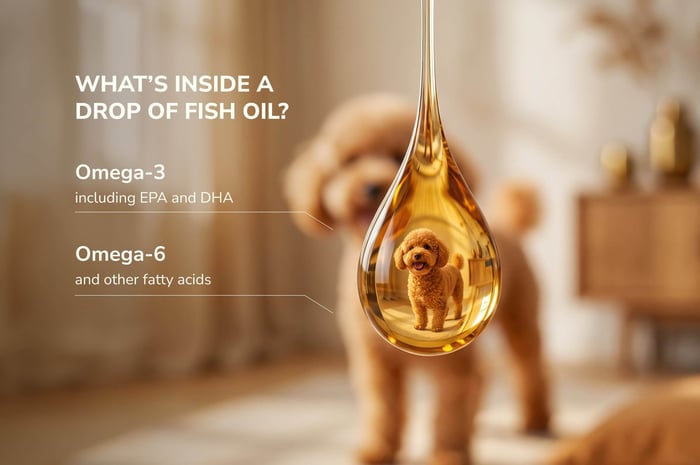
Imagine placing one golden drop beneath a microscope. It looks beautifully simple, transparent, uniform. Almost identical regardless of which bottle it came from. Yet hidden inside that tiny droplet is a remarkably complex mixture of different fatty acids, each with its own biological role.
That was one of the first lessons that stayed with us. We often talk about fish oil as though it were a single ingredient, when in reality it is a carefully balanced composition. Saying that a supplement contains fish oil is a little like saying a forest contains trees. It is technically correct, but it tells us very little about what makes one forest different from another.
Understanding that composition changes the way we compare every bottle on the shelf.
Omega-3 and Omega-6: partners, not rivals
One of the first distinctions we encounter inside that drop is between two families of fatty acids: Omega-3 and Omega-6. If you've spent any time reading about nutrition, you've probably come across the idea that Omega-3 is somehow "good" while Omega-6 is "bad."
Biology tells a much more interesting story.
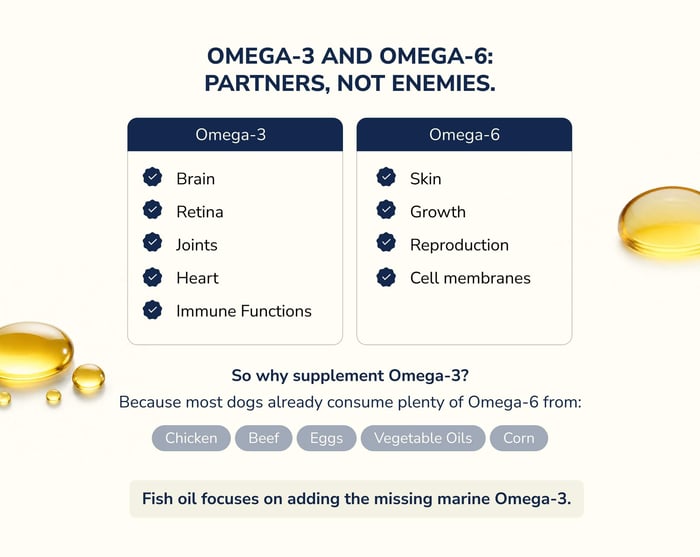
Dogs need both. Omega-6 fatty acids play essential roles in healthy skin, normal growth, reproduction and many physiological processes that occur every day without us ever noticing them. Without Omega-6, a dog cannot thrive.
The question, therefore, isn't whether Omega-6 is important. It absolutely is. The more relevant question is whether today's diets already provide enough of it. In most cases, they do.
Whether a dog eats kibble, canned food, a BARF diet or carefully prepared home-cooked meals, ingredients such as poultry, beef, pork, eggs and many vegetable oils naturally contribute generous amounts of Omega-6 fatty acids.
Marine Omega-3, by contrast, is often present in much smaller amounts. That observation is far more important than it first appears.
Because it explains why so many owners decide to supplement with fish oil in the first place. The purpose of an Omega-3 supplement isn't to replace Omega-6. It's to increase the intake of the long-chain marine Omega-3 fatty acids that are often comparatively less abundant in everyday diets.
Understanding that distinction changes the conversation completely. The goal isn't to remove one family of fatty acids. It's to restore balance between two families that the body depends upon for different reasons.
What about Omega-9?
As we compared labels, another claim kept appearing: "Omega-3-6-9."
At first glance, it sounds reassuring. After all, if Omega-3 is important and Omega-6 is essential, surely adding Omega-9 must make a supplement even better. Not necessarily.
Unlike Omega-3 and Omega-6, Omega-9 is not an essential fatty acid. Healthy dogs can synthesise it naturally, and it is also present in many everyday foods.
That doesn't mean Omega-9 lacks nutritional value. Oleic acid, the principal Omega-9 fatty acid found in olive oil, contributes to normal cell function and forms part of a healthy diet.
But if the purpose of a supplement is to increase the nutrients that are most commonly underrepresented in modern canine diets, marine Omega-3 remains the priority.
Once again, purpose matters. Every ingredient should be there for a reason.
The two letters that matter more than the words "Omega-3"
During our research, another pattern quickly became impossible to ignore. Almost every bottle proudly declared that it contained Omega-3. Very few explained which Omega-3. At first, that might seem like a minor detail.It isn't.
Omega-3 is not a single nutrient. It is an entire family of fatty acids, and within that family two members deserve particular attention: EPA and DHA.
Although they are often mentioned together, and rightly so, they are not interchangeable. EPA is widely recognised for supporting healthy joints, cardiovascular function, immune health and a balanced inflammatory response.
DHA performs a different, but equally remarkable, role. It is one of the principal structural components of the brain and retina. Rather than simply supporting the nervous system, it literally becomes part of it.
That distinction changed the way we looked at every bottle on the shelf. We stopped asking whether a supplement contained Omega-3. We started asking how much EPA and DHA it actually provided.
And that single question became one of the foundations upon which MegaLoona was eventually developed.
Why EPA and DHA deserve their own place on the label
At this point, you may be wondering why nutrition scientists place so much emphasis on EPA and DHA rather than simply talking about Omega-3 as a whole.
The answer is surprisingly practical. Imagine standing in front of two bottles. Both proudly declare "Rich in Omega-3." Both contain fish oil. Both have similar packaging and a similar price.
Without looking any further, they appear almost identical. Now imagine turning each bottle around. One tells you exactly how much EPA and DHA your dog receives in every serving. The other doesn't mention them at all. Which bottle tells you more about what your dog is actually eating?
The first one. Not because it is automatically the better product. But because it allows you to make an informed decision. Transparency is one of the first signs of a thoughtfully designed nutritional product. When manufacturers declare EPA and DHA, they are giving owners meaningful information rather than relying on broad claims that sound reassuring but reveal very little.
That doesn't mean a product without declared EPA and DHA is necessarily poor. There may be perfectly valid reasons why they aren't listed, depending on local regulations, analytical testing or formulation.
It simply means that, as consumers, we can compare far more confidently when those values are available. This is why the first question in our Pocket Guide is so simple.
Does the label clearly declare EPA and DHA? Because once you know those numbers, everything else starts making more sense.
💡 What to remember
You're not really buying "Omega-3." You're buying the EPA and DHA that your dog will actually receive.
Why has Omega-3 become one of the most studied nutrients in canine nutrition?
Once we understand the difference between Omega-3 and EPA+DHA, another question naturally follows.
Why has so much research focused on these two fatty acids? The answer isn't that they are a miracle nutrient. There are no miracle nutrients. Health is built through thousands of biological processes working together, not through a single ingredient.
What makes EPA and DHA remarkable is the sheer number of systems in which they participate.
Over the past few decades, researchers have explored their role in brain development, vision, skin and coat health, joint function, cardiovascular health, immune regulation and healthy aging. Today, EPA and DHA are among the most extensively studied fatty acids in both human and veterinary nutrition.
That doesn't mean every study reaches the same conclusion, nor that Omega-3 is appropriate for every clinical condition. Science rarely offers such simple answers.
Instead, something more interesting has happened. Across hundreds of studies, one consistent theme has emerged. EPA and DHA aren't working in just one organ. They are incorporated into cells throughout the body. Cell membranes, the retina, the brain, the skin, the immune system.
In many ways, they become part of the body's own architecture. Perhaps that is why Omega-3 is so often discussed in relation to overall wellbeing rather than a single health outcome. It isn't acting in one place. It's participating in many.
A nutrient for life, not just for problems.
This perspective also changes another common misconception. Many owners first discover Omega-3 because their dog develops a problem. Perhaps a veterinarian recommends it for itchy skin. Perhaps an older dog begins to struggle with stiff joints. Perhaps they read about cognitive ageing.
It's easy to conclude that Omega-3 is something we introduce once a problem appears. But nutrition doesn't usually work that way. We don't eat vegetables because we have scurvy. We don't drink water because we're already severely dehydrated. Good nutrition is fundamentally preventative. It helps the body maintain normal physiological function long before something goes wrong.
Omega-3 belongs in that same conversation. Supporting healthy skin is valuable. Supporting normal brain function is valuable. Helping maintain healthy joints throughout life is valuable.
The fact that these same nutrients are also being investigated in clinical settings doesn't diminish their role in everyday nutrition.
If anything, it reminds us how biologically important they are.
From puppies to senior dogs
One of the remarkable things about Omega-3 is that its importance doesn't belong to one stage of life.
It changes as dogs grow. During pregnancy and early development, DHA contributes to the normal development of the brain and retina. As dogs mature, EPA and DHA continue to support healthy skin, joints, cardiovascular function and normal immune responses. Later in life, they remain important components of healthy aging, particularly for cognitive function and mobility.
The same nutrient. Different roles. A lifetime of relevance.
If Omega-3 is so valuable… why isn't it in every dog food?
This is one of the questions we are asked most often. And it's an excellent one.
If marine Omega-3 contributes to so many aspects of health, why don't all complete dog foods simply contain generous amounts of EPA and DHA? The answer begins with understanding the difference between nutritional adequacy and nutritional optimisation.
These two concepts are often confused, yet they answer entirely different questions.
Nutritional adequacy asks: Does this food provide everything a healthy dog needs to avoid deficiency and maintain normal physiological function?
This is the question addressed by nutritional standards and feed legislation.
Across Europe, organisations such as FEDIAF establish nutritional guidelines for complete pet foods. These recommendations define essential nutrients that complete diets should provide for different life stages, helping manufacturers formulate foods that are safe and nutritionally balanced.
That framework is enormously important. Without it, there would be no common nutritional standard for complete pet foods. But nutritional adequacy isn't the same as nutritional optimisation.
Optimisation asks a different question altogether. If we wanted to support long-term health as well as current scientific knowledge allows, would we formulate the recipe exactly the same way?
Those are not regulatory questions. They are formulation questions. Scientific questions. Sometimes even philosophical questions. And that distinction matters.
For healthy adult maintenance diets, current nutritional standards do not require manufacturers to include EPA and DHA as essential nutrients in the same way they require protein, calcium or many vitamins and minerals. Manufacturers are therefore free to include marine Omega-3, or not.
Many do. Some don’t. Many include modest amounts. Some include considerably more. Others rely on ingredients that naturally contribute small quantities. They are simply different formulation decisions.
This is one of the reasons we believe dog owners benefit from understanding nutrition rather than memorising numbers.
Because nutrition isn't about finding the correct number. It's about understanding which question that number was designed to answer.
Was it designed to prevent deficiency? To formulate a complete food? To support a particular life stage? Or to optimise a healthy dog's nutrition beyond minimum requirements? Those are very different questions. And they deserve different answers.
When we began developing LOONAWELL's complete foods, this distinction became one of our guiding principles. Meeting nutritional standards was never the finish line. It was the starting point. From there, every ingredient had to justify its place. Not because regulations demanded it, but because we wanted every ingredient to make a meaningful nutritional contribution.
That philosophy eventually became one of LOONAWELL's founding principles: Every ingredient must have a positive nutritional purpose. It is a simple sentence, but it has shaped every recipe we've created since.
So... how much Omega-3 does a healthy dog actually need?
By now, you may have noticed something curious. We've spent thousands of words discussing Omega-3, we've explored EPA and DHA, we've looked at labels, we've talked about formulation philosophy, and yet we still haven't answered what many owners expect to be the very first question.
How much does my dog actually need? There is a reason we've waited until now. Because this question deserves a more honest answer than a single number.
When we think about nutrients such as vitamin C for humans, we're used to the idea of a recommended daily intake. It feels reassuring. One number. One target. Meet it, and you're doing well. It would be comforting if Omega-3 worked in exactly the same way, but it doesn't.
Unlike many vitamins and minerals, there is currently no universally accepted daily recommendation for EPA and DHA in healthy adult dogs that everyone agrees should apply in every situation. At first, that may sound surprising, but once we understand why, it begins to make perfect sense.
Remember the distinction we discussed earlier between nutritional adequacy and nutritional optimisation? This is where those two ideas meet. A scientist investigating cognitive aging may choose one level of EPA and DHA. A veterinarian managing a specific medical condition may recommend another. A nutritionist formulating a complete food asks a different question again. And a manufacturer designing an Omega-3 supplement is solving yet another nutritional challenge.
Each recommendation answers a different question. So naturally, the numbers are different too.
The mistake is assuming that one of them must therefore be "the correct one." Usually, they are simply answering different questions.
This is one of the reasons nutrition can sometimes appear confusing from the outside.
One article says a dog needs one amount. Another recommends considerably more. A supplement suggests something different again.
Rather than seeing these as contradictions, it helps to think of them as different points on the same map. They're all trying to guide the reader. They're simply starting from different destinations.
Perhaps an analogy helps. Imagine asking, "How much exercise should a person do every day?" The answer depends. Are we talking about maintaining general health? Training for a marathon? Recovering from surgery? Improving cardiovascular fitness?
The question matters just as much as the answer. Omega-3 is remarkably similar.
The amount that supports a growing puppy may not be identical to the amount chosen for a healthy adult. The amount used in a clinical study isn't necessarily the amount appropriate for everyday supplementation. Context changes everything.
For us, this was one of the most important lessons we learned while developing MegaLoona.
Rather than searching for a magical number, we focused on a different objective: How could we design a supplement that delivers meaningful amounts of EPA and DHA in a way that is simple, flexible and practical for owners to use every day?
That philosophy shaped not only the formulation itself, but also the serving guide. Instead of asking owners to calculate milligrams from analytical reports, we wanted them to think in something much simpler: Sprays.
A small West Highland Terrier shouldn't receive the same amount as a Great Dane. But neither should owners need a calculator every morning. Our recommended daily serving therefore scales naturally with body size while delivering consistently high levels of EPA and DHA in every spray.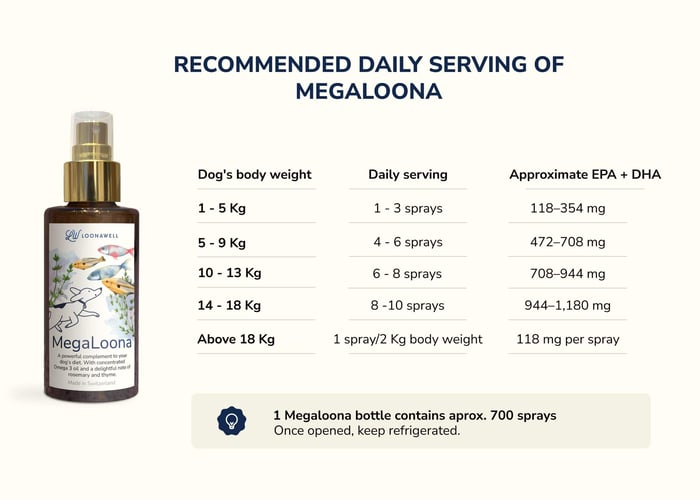
Rather than representing the correct amount of Omega-3, this table represents something much more practical. It is the serving guide for one carefully designed formulation. And that distinction is important.
The second question that changes everything
By now, we've answered our first question: We know why EPA and DHA deserve our attention. We understand why they matter more than the broad claim of "Contains Omega-3."Now we can turn to the second question: Is the formulation truly focused on delivering marine Omega-3? At first glance, the answer might seem obvious.
If a bottle is called an Omega-3 supplement, surely its purpose is to provide Omega-3. Surprisingly, that's not always as straightforward as it sounds.
One of the most interesting discoveries we made while comparing products had nothing to do with EPA, nor DHA, nor even bottle size. It had to do with ingredients.
When you look at the front of a bottle, almost every product tells a similar story. Fish oil. Wild salmon. Omega-3. Premium quality. But when you turn the bottle around, the ingredient list sometimes tells a rather different one.
Some formulations consist almost entirely of marine fish oil. Others combine fish oil with substantial quantities of additional vegetable oils. Those oils are not inherently undesirable. Many, such as olive oil, have their own nutritional characteristics.
The point isn't that they should never appear in an ingredient list. The point is understanding the purpose of the product you're holding. If you're buying an Omega-3 supplement because you want to increase your dog's intake of marine EPA and DHA, it seems reasonable to expect that most of the bottle is dedicated to delivering exactly that.
The formulation should reflect the product's purpose. When we developed MegaLoona, we kept coming back to the same question: If someone buys an Omega-3 supplement, what should they predominantly find inside the bottle? For us, the answer was uncomplicated: Marine Omega-3. That became the starting point for every subsequent decision.
Today, MegaLoona consists of 97.5% marine Omega-3 oil. The remaining 2.5% serves a specific purpose: a small amount of extra virgin olive oil infused with thyme, selected not to dilute the formulation but to support the stability and sensory characteristics of the finished product. The percentages themselves aren't what matter most. The philosophy behind them is.
Every ingredient should be able to explain why it is there. If it can't...it probably shouldn't be.
💡 What to remember
If you're buying an Omega-3 supplement, Omega-3 should be the main ingredient—not simply the headline on the front of the bottle.
Bigger bottles don't necessarily deliver more Omega-3
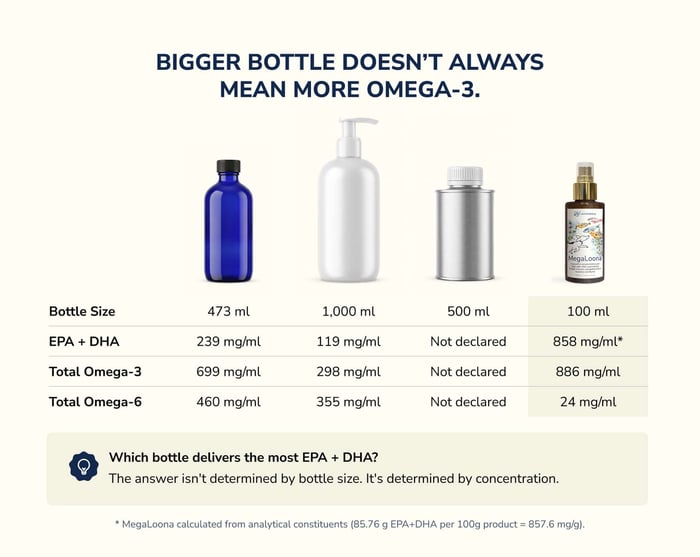
Imagine two bottles sitting next to each other on a shelf. One contains 250 millilitres and the other contains only 100. Without thinking too much about it, which one feels like the better value? Most of us instinctively choose the larger bottle. After all, more liquid usually feels like more product. But nutrition rarely rewards intuition. It rewards curiosity 😊.
Because a larger bottle doesn't automatically contain more EPA and DHA. In fact, a smaller bottle with a much higher concentration of marine Omega-3 can deliver considerably more of the nutrients you're actually looking for than a bottle two or three times its size.
This was another moment that completely changed the way we compare supplements. Instead of comparing bottles...we started comparing nutrients. And once we did that, many products that looked almost identical suddenly looked very different.
Imagine buying orange juice. One bottle contains mostly freshly squeezed juice. Another contains far less juice and considerably more water. If both bottles cost the same, comparing them only by volume wouldn't tell you very much.
You'd naturally want to know how much actual fruit each glass contains. Omega-3 deserves the same logic. The bottle is only the container. EPA and DHA are what you're really taking home.
💡 What to remember
Don't compare bottle size. Compare how much EPA and DHA each serving actually delivers.
The fourth question
We've reached our final question. Perhaps unsurprisingly, it's also the simplest: What else is inside the bottle?
Not because every additional ingredient is undesirable and certainly not because a shorter ingredient list is always better. The question is much more fundamental: Does every ingredient have a clear nutritional purpose?
That single question can completely change the way we read labels.
One of the easiest traps in nutrition is assuming that more ingredients automatically mean a better product. We've all seen labels that proudly list ten oils, twelve botanical extracts and an impressive collection of scientific names.
They certainly look sophisticated. But complexity isn't the same as quality. Sometimes, excellent formulation is about knowing what not to add.
Every ingredient occupies space. Every ingredient influences the final composition. Every ingredient should justify why it belongs there. If it cannot answer that question… perhaps it doesn't belong. This philosophy has guided LOONAWELL since the very beginning.
Long before we created supplements, before we developed complete foods, before we even chose our first ingredients, we agreed on one principle that would shape every product we would ever make.
Every ingredient must have a positive nutritional purpose.
Not a marketing purpose. Not a decorative purpose. A nutritional purpose. It's a deceptively simple sentence. Yet it has become one of the hardest rules we follow. Because every new ingredient has to earn its place. Sometimes that means saying no. And in formulation, saying no is often much harder than saying yes 😊.
When we developed MegaLoona, we returned to that principle repeatedly.
Should we add another oil? Only if it contributes something meaningful. Should we increase the number of ingredients? Only if doing so genuinely improves the nutritional design. Could we explain the purpose of every ingredient to a curious dog owner? If the answer was no… we went back to the drawing board.
By the end of the process, the formulation had become remarkably straightforward and not because simplicity is fashionable but because, in this case, simplicity served the nutritional objective.
Inside MegaLoona
After everything we've discussed, perhaps this is the easiest label to understand.
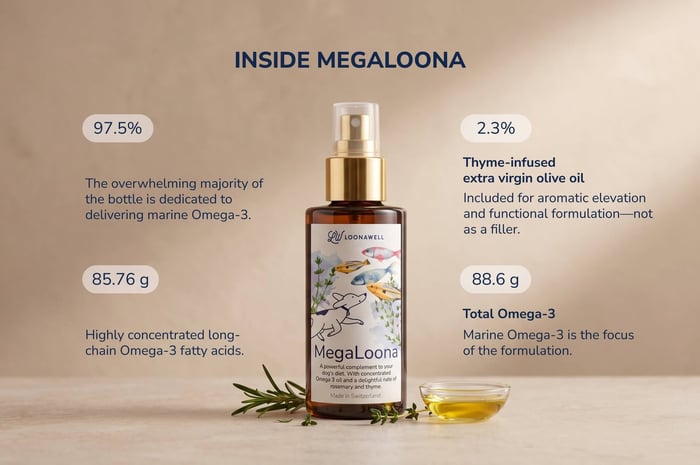
Imagine looking inside the bottle. Almost all of what you see is there for one reason. To deliver marine Omega-3:
- 97.5% marine Omega-3 oil
- 88.6 g total Omega-3 per 100 g
- 85.76 g EPA + DHA per 100 g
- 2.4 g Omega-6 per 100 g
- 2.3% thyme-infused extra virgin olive oil
None of those numbers exists to impress and each of them answers a question. How much of the formulation is dedicated to marine Omega-3? How much EPA and DHA does it actually contain? How much Omega-6 accompanies it? What role does every ingredient play?
By themselves, numbers don't tell stories. But when they answer meaningful questions, they become surprisingly powerful.
Your Pocket Guide
Let's return to the four questions we promised to answer at the beginning.
The next time you pick up an Omega-3 supplement, you don't need to remember every paragraph you've just read.
You only need to remember these.
1. Does the label clearly declare EPA and DHA?
Those are the marine Omega-3 fatty acids you're really looking for.
If they are declared, you can compare products with much greater confidence.
💡 What to remember: You're not buying "Omega-3". You're buying the EPA and DHA your dog will actually receive.
2. Is the formulation truly focused on delivering marine Omega-3?
Look beyond the front of the bottle.
Read the ingredient list.
Ask yourself whether the formulation reflects the product's purpose.
💡 What to remember: If you're buying an Omega-3 supplement, marine Omega-3 should be the heart of the formulation.
3. What matters more: bottle size or EPA and DHA concentration?
Large bottles can be reassuring. But bottles don't nourish dogs. Nutrients do. Compare what each serving actually delivers.
💡 What to remember: Don't compare bottle sizes. Compare nutrients.
4. What else is inside the bottle?
Every ingredient should have a reason for being there. Not because more ingredients are automatically worse. But because thoughtful formulation begins with thoughtful choices.
💡 What to remember: The best ingredient lists don't simply tell you what's inside. They help you understand why.
A different way of looking at nutrition
When we began this article, we stood together in front of a shelf full of fish oil bottles. At first glance, they all looked remarkably similar. Now, I hope they don't. Not because one bottle is necessarily better than another, but because you now know what questions to ask.
Perhaps that's the most important role good nutritional education can play. Not telling people what to buy. Teaching them how to think. Because once you know how to ask better questions, labels become easier to understand. Marketing becomes easier to recognise. And good formulation becomes easier to appreciate.
One final thought
When people ask us what makes a good Omega-3 supplement, they often expect us to answer with a number, or a concentration, a percentage, or a dosage. Those things matter, but after everything we've explored together, I don't think they're where the story really begins.
It begins with curiosity. With turning the bottle around. With reading beyond the headline and with asking why each ingredient is there. With recognising that nutrition is rarely about finding the biggest number. It's about understanding what that number was designed to tell you. Perhaps that's why we care so deeply about education at LOONAWELL. Because we don't believe excellent nutrition starts in a factory. Or even in a recipe. We believe it starts much earlier. It starts the moment someone becomes curious enough to ask a better question.
And if this article has helped you do exactly that… then it has achieved everything we hoped it would.
At LOONAWELL, we believe that every ingredient should have a positive nutritional purpose. Perhaps the same is true for knowledge. Every fact should help us make a better decision.
MegaLoona, complément pour chien

CHF. 57.00
Des oméga-3 essentiels en toute simplicité pour chaque chien, à chaque repas ! Les oméga-3 sont essentiels à la santé de votre chien, mais ils sont malheureusement absents de la plupart des régimes alimentaires. Pourquoi choisir MegaLoona pour votre chien ? Soutien essentiel en oméga-3 : Les chiens ne peuvent pas produire d'oméga-3 par eux-mêmes... Lire la suite