
Table of Contents
Rethinking Hydration Through a Dog's Eyes
Summer has a way of bringing hydration and moisture into focus. We carry water bottles on walks, seek shade during the warmest hours of the day and make sure our dogs have access to fresh water wherever they go.
These seasonal habits are important. They also raise an interesting question: When we think about hydration, are we thinking only about what our dogs drink? Or should we also consider what they eat?
During my years working in biomedical sciences and nutrition, I noticed that certain topics received enormous attention, while others quietly accompanied almost every biological process in the background. Water was one of them.
We often discuss protein, vitamins, minerals, antioxidants and other nutrients when talking about nutrition. Yet the nutrient that participates in virtually every physiological process is often the one we pay the least attention to: water.
Water helps with:
- transporting nutrients,
- regulating body temperature,
- digestion,
- removing waste products
- and maintaining normal cellular function.
Without it, life simply cannot exist.
In fact, the body of an adult dog is composed of approximately 60% water, although this can vary depending on age, body composition and overall health status.
When viewed through that lens, hydration begins to feel less like a seasonal concern and more like a fundamental aspect of canine biology.
This naturally leads to a simple question: where does a dog's daily moisture come from?
Looking from the Inside Out
Let us begin with the dog.
The body of an adult dog is composed largely of water. Every organ, tissue and cell depends upon it.
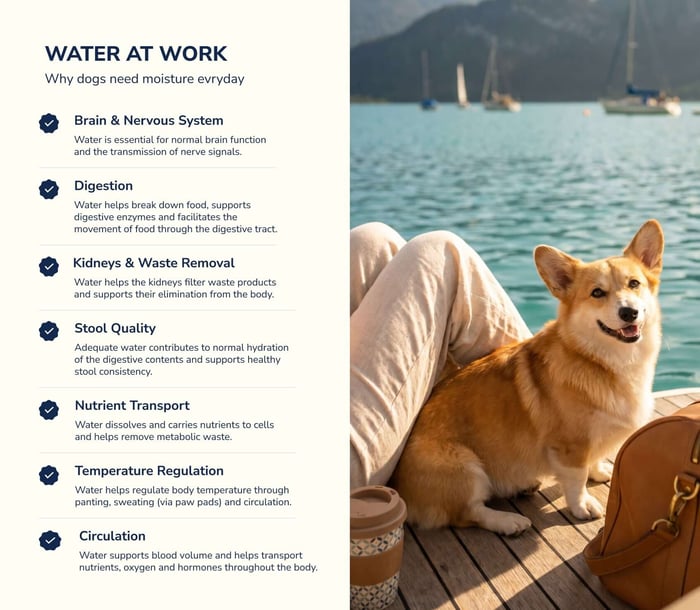 Image Caption
From the perspective of the body itself, the requirement is remarkably straightforward: sufficient moisture must be available for these processes to take place.
The question then becomes: where does that moisture come from?
That is where the conversation becomes far more interesting.
Looking from the Outside In
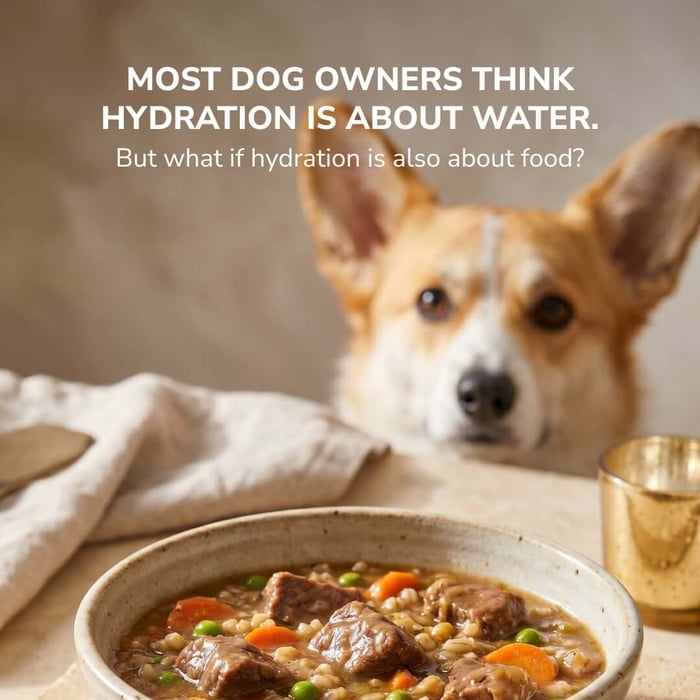
The picture becomes more nuanced when we consider how dogs obtain that moisture. Different feeding approaches provide very different amounts of water. Dry kibble typically contains around 8–10% moisture, while air-dried foods often contain 15–25%. Wet foods and fresh foods frequently contain between 70–85%.
One aspect of this comparison has always captured my attention. When a dog is fed a dry diet, whether kibble or air-dried food, its daily moisture intake depends far more heavily on drinking water. The dog must actively seek, consume and replace the moisture that is not present in the food itself.
Some dogs drink enthusiastically. Others do not. Elderly dogs often drink less. Some dogs also drink less while travelling, exercising, stressed or exposed to unfamiliar environments.
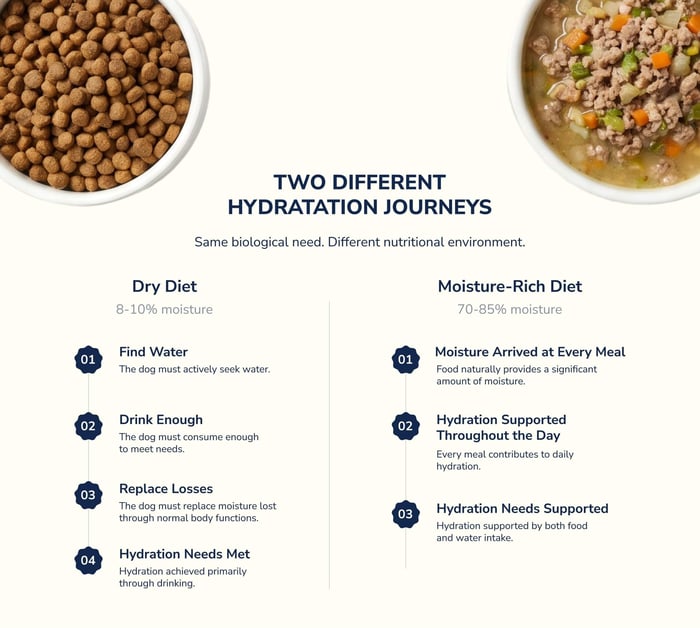
At the same time, the owner carries a greater responsibility to ensure fresh water is always available and consumed in sufficient quantities.
A high-quality moisture-rich diet changes that equation. Every meal contributes to hydration. As a scientist, this matters to me.
The more I studied canine physiology, the more convinced I became that nutrition should work with the body's natural needs rather than ask the body to compensate for what food does not provide.
Dogs evolved consuming foods naturally rich in moisture. Their bodies depend on water for virtually every physiological process. From my perspective, providing part of that water through high-quality, moisture-rich food is not simply a matter of hydration. It is a more biologically coherent way of feeding.
This is one of the reasons I strongly favour high-quality moisture-rich diets and why moisture has always been an important part of the LOONAWELL philosophy.
Summer Changes the Equation
A cool morning in spring and a warm afternoon in July do not place the same demands on a dog's body.
As temperatures rise, dogs rely increasingly on panting to regulate body temperature. Physical activity, travel, outdoor adventures and warmer environments all increase water losses and, consequently, the need for hydration.
This is where moisture becomes particularly relevant.
When a dog is fed a moisture-rich diet, part of that hydration arrives naturally with every meal. Food itself contributes to replacing some of the water that is continuously lost throughout the day.
A dry diet creates a different situation. Because the food contributes relatively little moisture, hydration depends far more heavily on drinking water. The dog must actively seek it and consume enough of it. Equally important, the owner must ensure that fresh water is always available.
On a warm day at the beach, during a long walk in the mountains or while travelling, this responsibility becomes even more apparent. Water bowls do not follow dogs everywhere. Someone needs to remember the water bottle. Someone needs to stop and offer water regularly. Someone needs to pay attention.
Summer does not change a dog's biological need for water. It simply increases the demand.
For this reason, I view moisture-rich nutrition as more than a feeding preference. It is one way of helping support hydration as part of the meal itself, particularly during the months when the body's need for water becomes even more apparent.
Moisture and the Digestive Journey
Hydration is only part of the story. Moisture also plays an important role within the digestive process itself.
Water is not simply something that accompanies food. It participates in digestion from beginning to end: Water is required for digestive enzymes to function, for nutrients to dissolve and for food to move normally through the digestive tract.
A meal containing 70–80% moisture enters the digestive system in a very different physical state from one containing 8–10% moisture.
One arrives already carrying substantial amounts of water. The other depends far more heavily on water consumed separately from the meal.
A moisture-rich meal contributes directly to that environment. A dry meal relies much more heavily on the dog obtaining sufficient water elsewhere. This distinction is often overlooked because we tend to separate food and water into two categories.
Food nourishes. Water hydrates. In reality, the relationship is far more interconnected.
Many foods provide both nutrients and moisture simultaneously. In doing so, they contribute not only to nourishment, but also to the digestive environment in which those nutrients are processed and absorbed.
Seen through this lens, moisture becomes more than a number on a label. It becomes part of the nutritional environment itself.
One clarification is worth making: A high-quality moisture-rich meal is not simply a dry meal with water added to it. Adding water to kibble may increase moisture intake, and in some situations this can be beneficial. However, moisture-rich foods differ in more ways than water content alone. Ingredient selection, processing methods, food structure and the overall nutritional matrix all contribute to how a meal is experienced by the body.
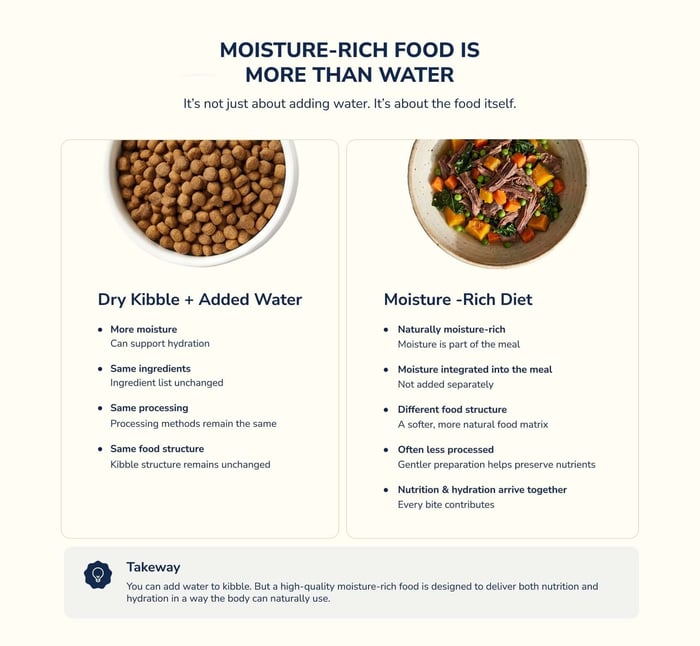
For this reason, when I speak about moisture-rich nutrition, I am referring to foods that are naturally formulated and prepared with substantial moisture as part of the meal itself, rather than water added as an afterthought.
A Broader View of Nutrition
When discussing canine nutrition, it is easy to focus on what is contained within the food.
Protein percentages, vitamin levels, mineral profiles, omega-3 fatty acids, antioxidants. All of these matter. Yet nutrition is more than a collection of nutrients. It is also the environment in which those nutrients are delivered.
Moisture is part of that environment.
The more I reflect on canine nutrition, the more I find myself returning to a simple question: What does a dog truly need to thrive? Not what is most convenient to manufacture. Not what is easiest to store. Not what has the longest shelf life. But what supports the biology of the animal itself.
The LOONAWELL Perspective
That question sits at the heart of LOONAWELL.
When I founded the company, I did not begin with manufacturing constraints or industry conventions. I began with the dog. Its physiology. Its nutritional needs. Its relationship with food.
That perspective has influenced every decision we make, from ingredient selection and recipe design to processing methods and moisture content.
Our Complete Food recipes contain approximately 65–75% moisture. Our pâtés contain similar levels.
Dorade Delight, Complete Food for Dogs

CHF. 42.80
Eine innovative Ergänzung für den Speiseplan Ihres Hundes: Diese handgefertigte Mischung aus hochwertigen Zutaten wurde entwickelt, um eine gesunde Vielfalt in die Ernährung Ihres Hundes zu bringen. Mit Dorade, Makrele und Bio-Eiern bietet sie ein ausgewogenes Proteingehalt, das für Hunde unerlässlich ist... Mehr lesen
Organic Lamb Paté

CHF. 22.00
The Lamb & Purple Potato Pâté is a deeply nourishing recipe built around organic lamb of Swiss origin, a well-tolerated protein naturally rich in iron, zinc, and vitamin B12. Developed through a lens of longevity-inspired nutrition, this recipe brings together ingredients… Read More
This is not a marketing claim. It is a reflection of how we think about nutrition. Water participates in virtually every physiological process in the body. Digestion depends on it. Hydration depends on it. Life depends on it.
To me, it makes sense that food should contribute to that reality rather than ask the body to compensate for its absence.
Fresh drinking water should always be available. That will never change. But I also believe food can do more. It can nourish, hydrate, it can support the body in multiple ways at the same time. Nutrition is not only about what is present in a meal. It is also about how that meal interacts with the biology of the animal eating it.
For me, that is where the most interesting questions begin.
FAQs
Why is moisture important in dog food?
Moisture contributes to hydration and also plays an important role in digestion. Water helps digestive enzymes function, supports nutrient transport and contributes to the movement of food through the digestive tract.
Do dogs need more water during summer?
Warmer temperatures, increased activity and panting can increase a dog's water requirements. During summer, dogs should always have access to fresh drinking water, whether at home, on walks, at the beach or while travelling. Moisture-rich foods and treats can also contribute meaningfully to daily hydration, making hydration part of the meal itself rather than relying solely on the water bowl.
Why does LOONAWELL formulate moisture-rich foods?
Because I believe dogs benefit from it.
Water participates in digestion, circulation, nutrient transport, temperature regulation and countless other physiological processes. Yet many modern feeding approaches (like kibble) contribute very little moisture through food itself.
At LOONAWELL, we chose a different starting point. We began with the dog and its physiology.
That is one of the reasons our Complete Food recipes contain approximately 68–73% moisture and our pâtés contain similar levels. I believe food should contribute to hydration rather than asking the body to compensate for its absence.