
Table of Contents
Winter requires nutrition with intention
February has a particular quietness to it and when we think about winter fruits & gentle antioxidants for dogs, that quietness becomes nutritionally meaningful. The rush of January has softened, the days are still short, and winter settles into its most honest rhythm. It is not a season of abundance, and that, nutritionally speaking, is precisely its strength, because the body benefits more from stability and moderation than from novelty.
At this time of year, many dog owners who share parts of their own diet with their dogs naturally wonder which winter fruits, if any, can be shared, and in what way.
Winter is not the moment for sweetness or excess, as lower activity levels and slower digestion favour nutritional moderation over stimulation. Dogs do not need fruit in the way they need proteins or fats, and winter is certainly not the season for indulgence.
However, when fruits are used with intention, in small quantities and for a clear physiological purpose, they can play a supportive role. In winter, that role is not energy or variety, but digestive comfort, subtle hydration, and targeted antioxidant protection
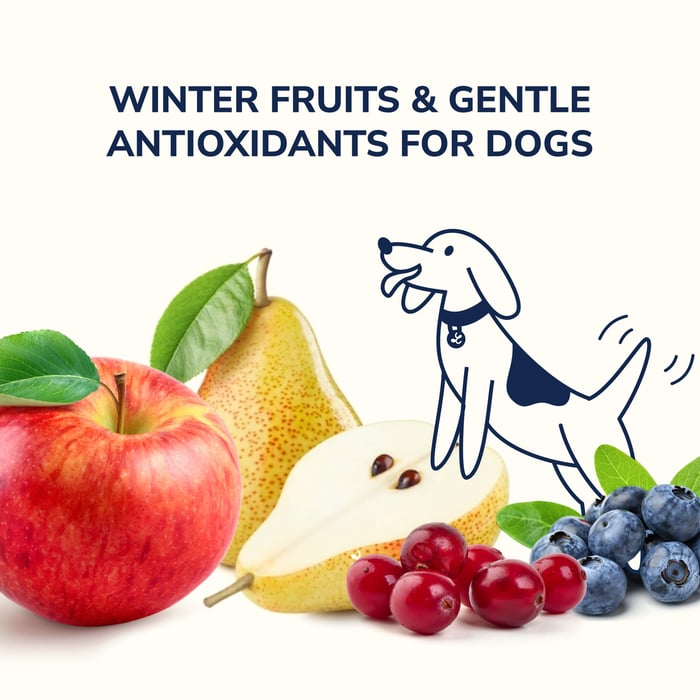
This is why I want to begin the year with a simple yet intentional quartet: apples, pears, cranberries, and blueberries. Four fruits that do not compete for attention, but work together, gently, to support digestion, hydration, and antioxidant protection during the colder months.
Winter nutrition is about precision, not variety
Winter changes the way a dog's body behaves.
As days grow shorter and colder, activity levels naturally decrease. Dogs spend more time resting, often indoors, in warmer and drier environments. Water intake can drop without being noticed. Digestion may slow slightly, not pathologically, but enough for some dogs, particularly seniors or those with sensitive stomachs, to become less tolerant of excess.
In this context, nutrition benefits less from accumulation and more from coherence. Adding ingredients simply to increase variety rarely improves outcomes; it more often increases digestive work and makes sensitivities harder to read. What does improve outcomes is selecting ingredients that work together physiologically, supporting the same functions, at the same pace, without creating internal friction.
In winter, fruits included in a dog’s diet should therefore serve a clear purpose. They should support digestion gently, contribute subtle hydration, and provide antioxidant protection without stimulating the system unnecessarily. Just as importantly, they should be easy to metabolise when energy expenditure is lower.
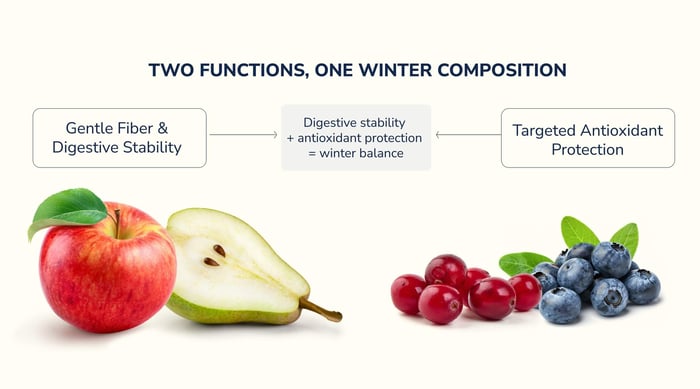
Apples, pears, cranberries, and blueberries meet these criteria not only individually, but collectively, each reinforcing the role of the others within a calm, balanced winter composition. This is why winter fruits & gentle antioxidants for dogs deserve to be considered together rather than in isolation.
Apple: Structure and digestive balance
Apples form the backbone of this winter combination.
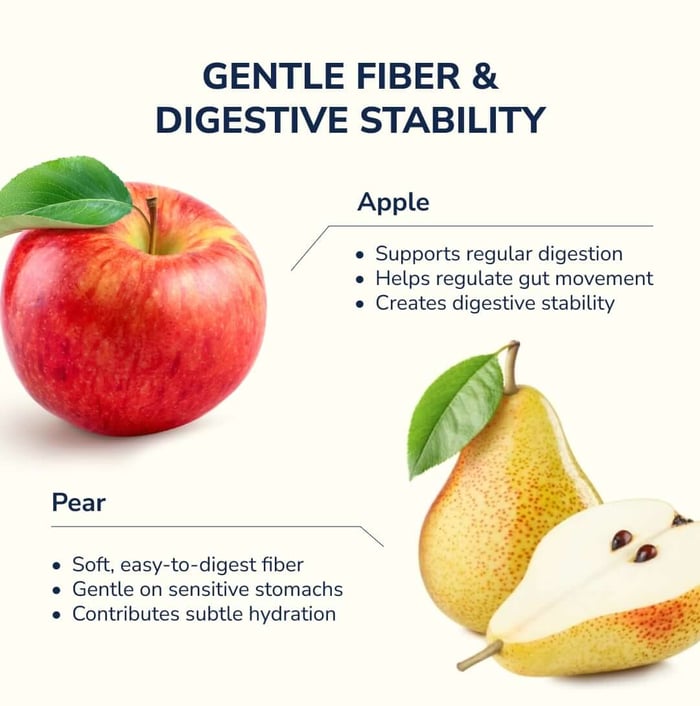
Rich in pectin, apples support gut health by helping regulate digestion, something that becomes particularly relevant when movement decreases and routines change. Their fiber is firm yet gentle, offering structure without heaviness.
In winter diets, apples help create a stable digestive environment. That stability matters because it reduces digestive “noise”: when the gut is calm, other functional ingredients, including antioxidants, tend to be better tolerated and more effective.
I personally love including apples when I cook pork for my dogs, Max and Luna. Whether I follow the recipe on page 169 of the LOONAWELL Cookbook (Pork Chops with Glazed Carrots) or prepare a personal variation at home, I find that the flavour of apple pairs beautifully with pork, and, judging by their enthusiasm, my dogs agree.
You can find a dedicated article on apples in our Knowledge Center, here , where we explore their benefits and appropriate quantities in more detail.
Pear: Softness and digestive tolerance
If apples provide structure, pears provide softness.
Their fiber is more delicate, often better tolerated by dogs with sensitive digestion. Pears also contribute subtle hydration, a practical benefit in winter, when many dogs drink less, even if their routine appears unchanged.
In combination with apple, pear rounds out the digestive profile of the meal. The aim is not contrast, but continuity.
You can find a dedicated article on pears in our Knowledge Center, where we explore their benefits and appropriate quantities in more detail.
Cranberry: Targeted antioxidant support
Cranberries are not included for abundance, but for purpose.
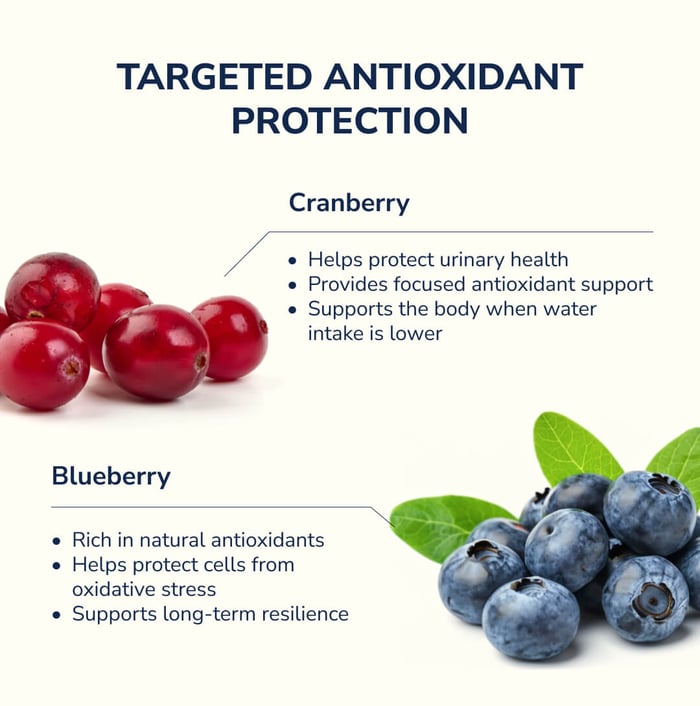
They are naturally rich in polyphenols, compounds known for their antioxidant properties. Traditionally associated with urinary tract support, cranberries can be especially relevant in winter months, when reduced water intake may place additional strain on the system.
Used in moderation, cranberries offer focused protection without overwhelming the digestive tract. Here you’ll find a dedicated guide to canine-friendly berries if you’d like to know more about these antioxidant power-houses.
Blueberry: Concentrated resilience
Blueberries bring depth to this combination.
They are one of the most concentrated sources of antioxidants commonly used in dog nutrition. Often frozen or gently processed to preserve their nutritional profile, blueberries show that seasonality does not mean compromise, it means choosing forms that preserve function.
And what better than a warm, fluffy pancake on a cold winter morning? If you already own the LOONAWELL Cookbook, I invite you to turn to page 197 and consider sharing a blueberry pancake moment with your dog, a simple way to bring comfort, flavour, and intention together.
Why combining matters more than spotlighting
Individually, each of these fruits has merit. Together, they create something more refined.
A balanced winter fruit combination for dogs pairs gentle fiber (apple and pear) with targeted antioxidants (cranberry and blueberry).
Gentle fibers from apple and pear help buffer the impact of antioxidant-rich fruits like cranberry and blueberry. Digestive stability allows antioxidants to do their work without stressing the system. The result is not stimulation, but quiet support.
This is the difference between knowing ingredients, and understanding how they interact.
Feeding with the season, not against it
Winter is not the time for dietary experimentation. It is a time for consistency, moderation, and respect for the body’s rhythm, especially for dogs who are sensitive, aging, or simply less active in the cold.
When I think about winter nutrition for dogs, I don’t think in terms of superfoods or trends. I think in terms of ingredients that behave predictably: they support digestion, maintain balance, and contribute benefits that the body can actually use in this season.
Apples, pears, cranberries, and blueberries do exactly that, not because they are fashionable, but because they are functional when used with restraint.
If you would like to explore each of these fruits in more depth, you can find dedicated articles on apples, pears, cranberries, and blueberries in our Knowledge Center. This article is an invitation to see them not as isolated ingredients, but as a thoughtful winter composition, and a practical answer to what, realistically, you can share when your own winter fruit bowl is on the table.
And if you would like to take this one step further, the LOONAWELL Cookbook offers practical ways to bring these ingredients into your own kitchen. Pears, for example, find a natural place in our pork and beef stew (page 166), where their softness and subtle sweetness balance the richness of the meat. Blueberries appear again in our blueberry pancakes (page 197), a simple, comforting recipe that allows you to share a winter morning ritual with your dog in a measured and intentional way. Recipes, after all, are where nutritional thinking becomes lived experience.
Le livre culinaire LOONAWELL 1ère édition

CHF. 112.00
Il ne s'agit pas d'un simple livre de cuisine. C'est une déclaration d'amour scientifique pour les chiens. Créé par l'équipe de LOONAWELL, ce livre de cuisine unique en son genre vous invite à nourrir votre chien avec la même attention, la même qualité et la même joie que vous apportez à votre... Lire la suite
FAQ
Which winter fruits can I confidently share with my dog?
Apples (without seeds or core), pears (without seeds), cranberries in appropriate quantities, and blueberries are among the most commonly used winter fruits for dogs. When offered in moderation and prepared properly, they can complement a balanced diet beautifully. Other fruits may also be suitable, but thoughtful preparation and portion awareness always matter more than variety.
Do dogs benefit from fruit in winter?
Dogs do not require fruit as a nutritional essential. However, certain fruits can contribute gentle fiber, hydration, and naturally occurring antioxidants that support balance during the colder months. In winter, fruit is not about sweetness, it is about subtle support.
How can I include fruit without upsetting digestion?
Keep portions modest, introduce fruits gradually, and observe your dog’s individual tolerance. For most dogs, fruit should remain a small addition to the main meal rather than a standalone component. When used intentionally, fruit can enhance a meal without overwhelming the digestive system.