

Table of Contents
- Before adding anything to the bowl, understand what the bowl already provides.
- First: what does “complete” actually mean?
- "Complete" establishes the foundation. Formulation determines what comes next.
- Completion: filling defined gaps in a particular diet
- What does complete mean for LOONAWELL?
- Enrichment: adding something for a purposeful reason
- Four questions to ask before adding a supplement
- Start with the diet. Then choose the supplement.
- FAQs
Before adding anything to the bowl, understand what the bowl already provides.
A customer recently asked us a wonderfully simple question:
"Could you make a powder containing all the vitamins and minerals my dog needs?"At first, the answer seemed straightforward. Then came the more important question: what is her dog already eating?
Imagine a sweet beautiful dog called Max. A healthy diet for Max must provide sufficient energy, protein and essential amino acids, vitamins, major minerals and trace elements in the right amounts and proportions. Those fundamental needs remain the same, regardless of the type of food he eats. What changes is how much of that nutritional architecture his diet already provides, and therefore what, if anything, should be added.
If Max eats a complete kibble or complete wet food, his recognised nutritional requirements should already be covered. If he eats a carefully formulated home-cooked recipe, supplements may be an integral part of making that recipe complete. If his home-cooked or raw meals have been assembled independently, we first need to examine the individual recipe before deciding what is missing.
So the useful question is rarely just: “Does Max need a supplement?”
The better question is: “What nutritional job does Max’s diet need the supplement to perform?”That job may be completion. Or it may be enrichment. The distinction matters.
First: what does “complete” actually mean?
“Complete” is a powerful word. When we see it on a dog-food label, it is natural to understand it as: This food provides everything my dog needs.
But in the context of your dog’s food label, “complete” is a legal term, and its legal meaning is narrower than many of us assume.
In Europe, Regulation (EC) No 767/2009, adopted in 2009 and still in force today, defines complete feed as:
“Compound feed which, by reason of its composition, is sufficient for a daily ration.”
The law stops there. It defines the promise made by the word “complete”, but it does not provide a detailed, nutrient-by-nutrient checklist for ordinary dog food.
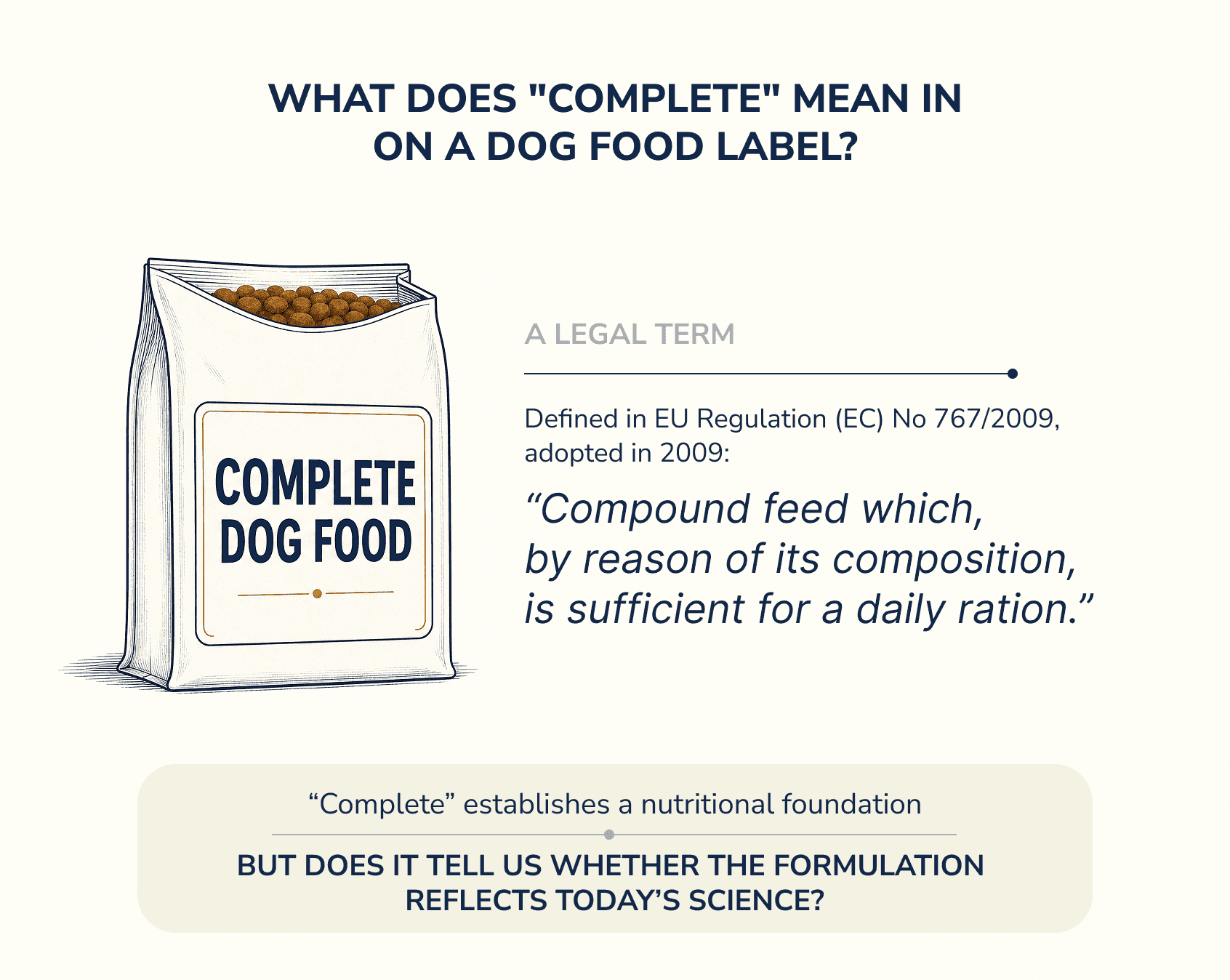
In practice, European pet-food companies generally turn to the nutritional guidelines published by the European Pet Food Industry Federation (or FEDIAF), the trade body representing national pet-food associations and manufacturers across Europe. In simple terms, EU law defines the promise; FEDIAF provides the industry’s nutritional rulebook for putting that promise into practice.
That distinction deserves some transparency. FEDIAF is not a government authority or an independent public-health institution. Its nutritional guidelines are developed with input from an independent Scientific Advisory Board and are widely used as an important scientific benchmark, but they remain industry recommendations, and business interests cannot simply be assumed to be absent from that context.
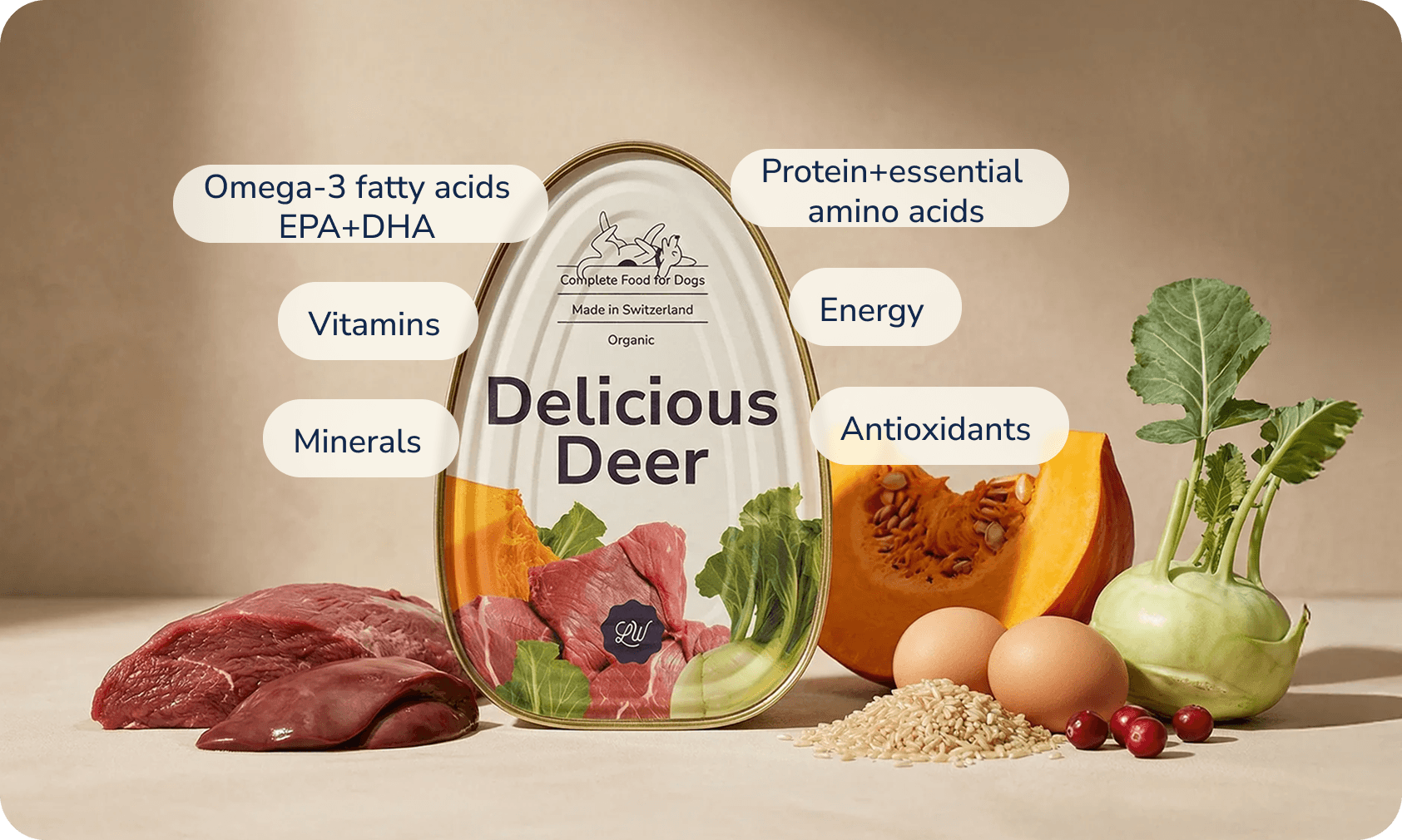
In practical terms, a “complete” food must be formulated to provide the recognised nutrients a healthy dog needs when fed in the recommended quantity and appropriate for that dog’s life stage. These include:
- sufficient energy;
- protein and essential amino acids;
- vitamins;
- major minerals; and
- trace elements;
all in the required amounts and proportions.
That is an important nutritional foundation. It is also the minimum standard a food must meet to carry the word “complete” on package.
The word itself does not tell us how far beyond that foundation a formulation goes. It does not tell us about the quality or diversity of its ingredients, whether particular beneficial nutrients are present in meaningful amounts, or whether the food was formulated with healthy ageing and longevity in mind.
Two foods can therefore both be called complete while offering substantially different nutritional profiles. One may be formulated to meet the established requirements. Another may deliberately go further. The same word appears on both labels.
"Complete" establishes the foundation. Formulation determines what comes next.
Omega-3 provides a revealing example.
Science has established important roles for omega-3 fatty acids throughout a dog’s life. The long-chain omega-3s EPA and DHA are particularly relevant to neurological and visual development, the regulation of inflammatory responses, and the support of skin, cardiovascular and joint health.
Yet for healthy adult dogs, the European nutritional guidelines currently establish no specific minimum recommended level for total omega-3, EPA or DHA. For ordinary adult-maintenance food, the decision to include meaningful amounts of omega-3, if any, remains with the individual company.
At LOONAWELL, we choose to include it.
If you have followed us for some time, you will already know how seriously we take omega-3 nutrition. We believe that meeting the standard for completeness is the beginning of responsible formulation. It should never be mistaken for the final limit of what nutrition can offer.
This is where the distinction matters: The word “complete” on a package describes a legal nutritional adequacy according to an established standard. It is not, by itself, a promise of optimal nutrition, healthy ageing or a longer life.Completion: filling defined gaps in a particular diet
A home-cooked meal may be prepared with enormous love, the best intentions and beautifully varied ingredients. But love and wholesome ingredients alone do not make a diet complete. Unless the recipe has been nutritionally formulated and the nutrients it is missing are supplied in calculated amounts, typically through its specified supplements, it cannot be assumed to provide the full recognised nutritional foundation a dog needs.
Some nutrients can be especially difficult to provide in the right quantities and proportions through a practical home-cooked recipe. Calcium is one familiar example. Iodine, zinc, copper, vitamin D and omega-3 (EPA and DHA) may also require close attention, depending on the ingredients used.
This is where supplements can perform the job of completion.
Completion does not mean sprinkling the same universal powder over every homemade meal. It means identifying the defined nutritional gaps in a specific recipe and supplying them in calculated amounts.
The recipe and its supplements must therefore be considered together, as one nutritional system.
What does complete mean for LOONAWELL?
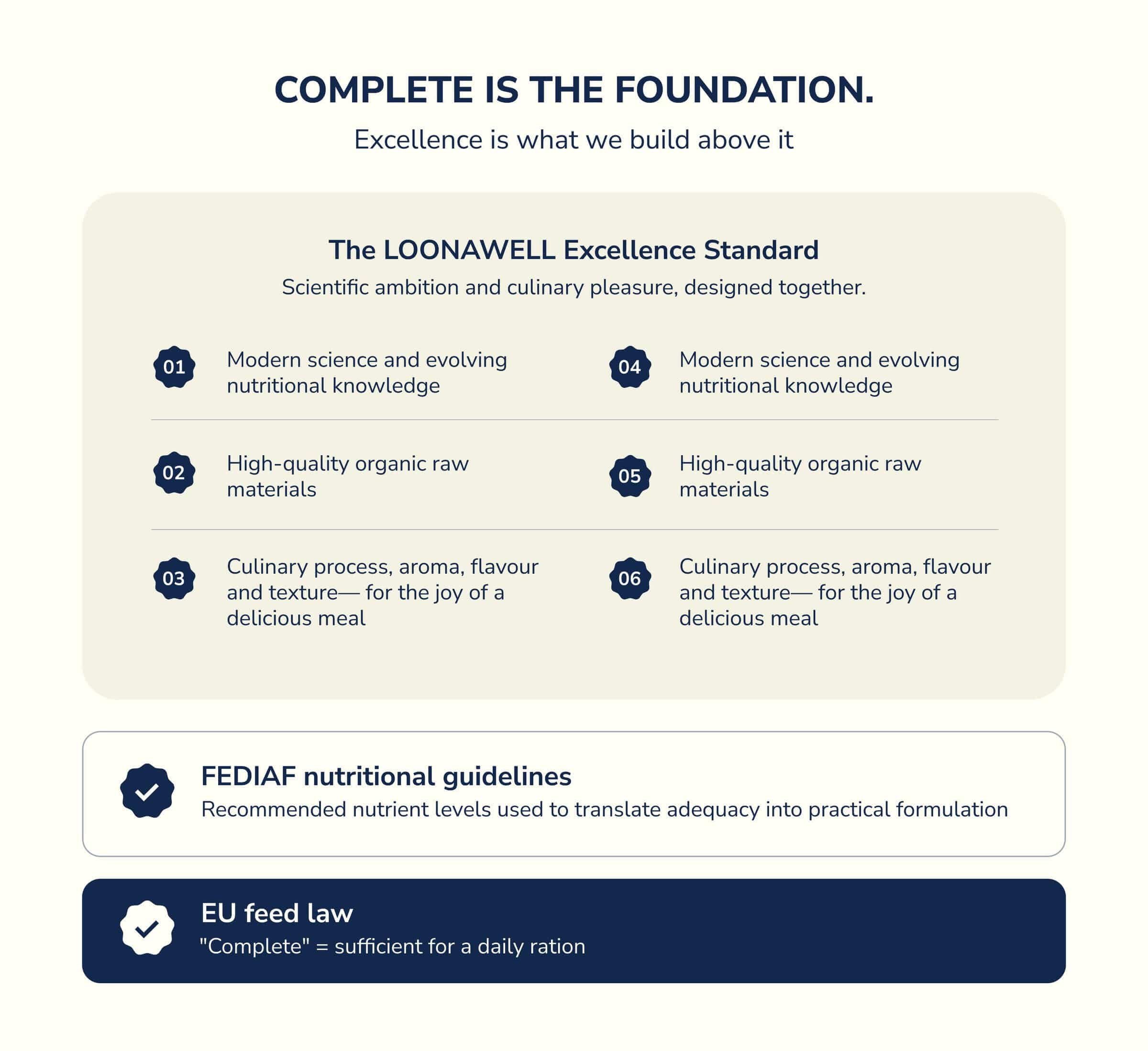
At LOONAWELL, the legal definition of complete is our starting point: the essential nutritional foundation every complete food must provide. It is the ground we build upon, not the ceiling of our ambition.
LOONAWELL was created to bring modern science and continually evolving nutritional knowledge into the dog’s bowl. Our ambition has never been to stop at the minimum considered sufficient for a daily ration. We ask what truly matters for a dog’s long-term health, vitality and quality of life, and translate that knowledge into purposeful formulation, with a longer horizon in mind: as many healthy, happy, good-quality years as possible.
1. The LOONAWELL complete food
Before we began formulating our complete foods, we sat down together and asked ourselves a deceptively simple question:
What would a dog food need to contain for us to wholeheartedly, and scientifically, call it excellent?
Our perspectives as biomedical scientists, food scientists and veterinary nutritionists came together in a shared set of criteria. This became the LOONAWELL Excellence List: the framework that guided our decisions from nutritional formulation and ingredient selection to sourcing and preparation.
The legal definition of complete provided the foundation. Our ambition was to explore how much further thoughtful formulation could go, applying current scientific knowledge to support long-term health, vitality and quality of life.
There is another part of LOONAWELL that shaped the food just as deeply: we are all dog parents, and we are all food lovers. We wanted our dogs to share in the pleasure and ritual of a good meal, the anticipation, the aromas, the flavours and the simple joy of eating something delicious.
That intention influences every part of the formulation. We select high-quality organic raw materials for their nutritional purpose and for how they work together. We consider flavour profiles, texture and aroma. We prepare nutritious, flavourful broths and follow a meticulous cooking and assembly process designed to preserve nutritional value while creating a meal dogs genuinely enjoy.
In a LOONAWELL complete food, nutritional analysis, precise completion, ingredient quality and culinary craft come together in one finished formulation. The word complete confirms that the recognised nutritional foundation has been provided. Everything else reveals the ambition with which the food was created.
2. The LOONAWELL cookbook + supplements
For home cooking, the complete diet is created differently. The selected recipe from the LOONAWELL cookbook provides the food-based foundation, while three complementary formulations contribute defined parts of the nutritional architecture:
Berry Bee provides selected vitamins and trace minerals, together with antioxidant-rich ingredients.
FlexiLoona provides calcium, alongside glucosamine, chondroitin and natural vitamin C.
MegaLoona provides a concentrated source of the marine omega-3 fatty acids EPA and DHA.

The exact cookbook recipe and the specified quantities of Berry Bee, FlexiLoona and MegaLoona have been formulated to work together. No single supplement completes the meal in isolation; each contributes a defined part of the whole.
A different home-cooked or BARF recipe creates a different nutritional starting point. We therefore cannot assume that the same combination will complete a meal that was formulated independently.
At LOONAWELL, complete is only the starting point. Excellence is what we build above it.Enrichment: adding something for a purposeful reason
Now imagine that Max eats a high-quality food labelled complete. His recognised nutritional foundation is already covered. Does that make every supplement unnecessary?
Not necessarily. But the purpose has changed.
Instead of correcting a nutritional gap required for completeness, we may choose to enrich the diet with selected nutrients or bioactive ingredients for a defined nutritional objective.
That objective might be to:
- increase the intake of the marine omega-3 fatty acids EPA and DHA;
- introduce a wider variety of antioxidant-rich ingredients;
- introduce selected probiotics to support the gut microbiome;
- provide targeted nutritional support for joints and mobility; or
- respond to a particular life stage, lifestyle or professionally identified need.
Enrichment should still be deliberate. A product does not become useful simply because it contains many ingredients, carries an appealing claim or is described as natural. We should be able to say what it adds, why it is being added and whether the underlying diet already supplies the same nutrients.
There is also an important distinction between nutritional enrichment and therapy. A supplement chosen to enrich the diet of a healthy dog is not the same as a product used as part of veterinary management for a diagnosed condition. The question determines the formulation, the dose and the evidence we should expect.
Four questions to ask before adding a supplement
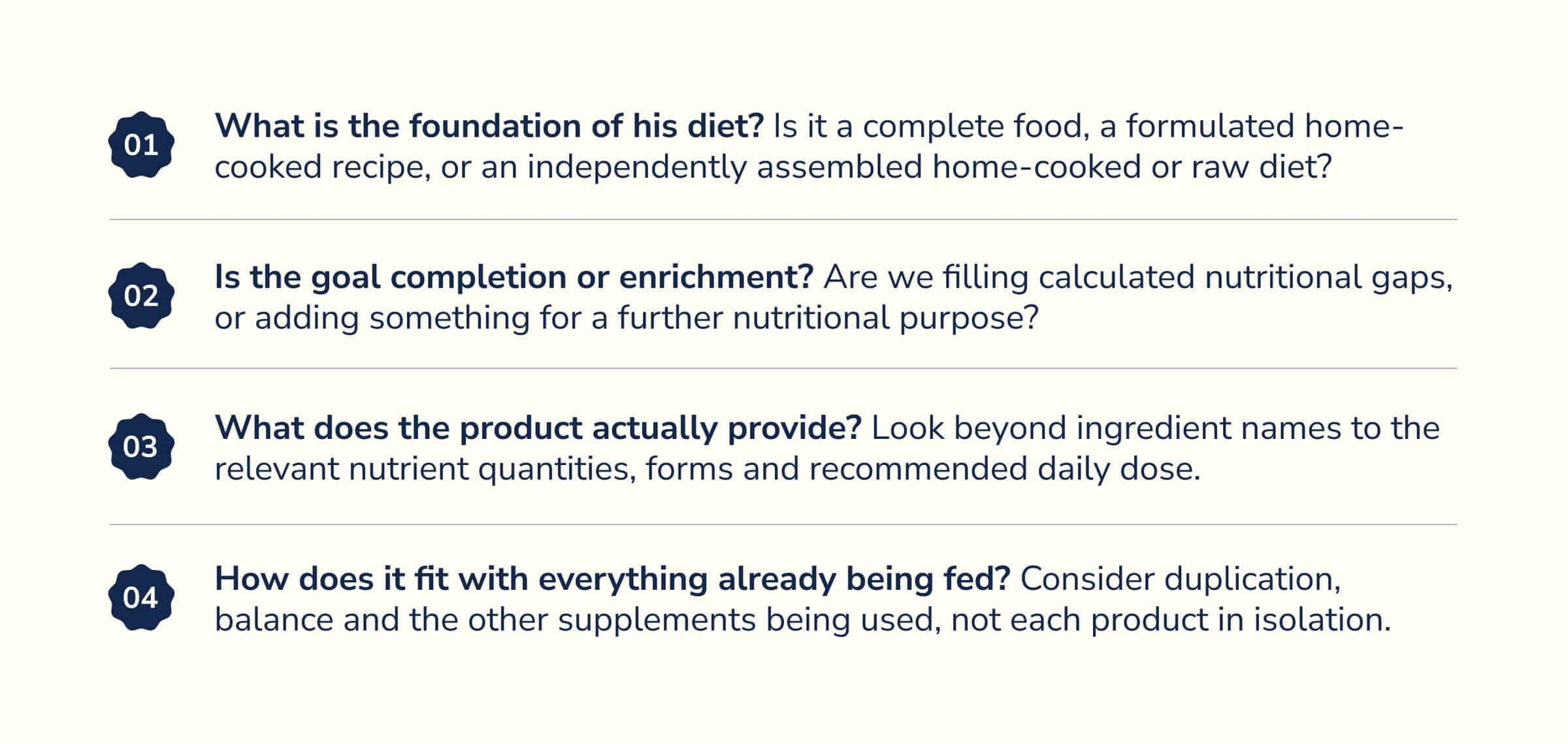
With the distinction between completion and enrichment clear, the next step is practical. Any supplement should be considered in the context of the dog, the diet already being fed and the nutritional job it is expected to perform.
Before adding anything new to Max’s diet, ask:
Start with the diet. Then choose the supplement.
So, could we make one powder containing all the vitamins and minerals a dog needs?
We could make a powder containing a very long list of nutrients. But without knowing what the dog eats, that list would not tell us whether the powder completes the diet, duplicates it or leaves important gaps untouched.
The thoughtful answer begins with the diet.
For Max, that means understanding his food, defining the nutritional objective and then choosing the product, or coordinated system, designed to fulfil it.
Because the best supplement is not the one that promises to do everything. It is the one designed to perform the nutritional job your dog’s diet actually requires.
MegaLoona, Nahrungsergänzungsmittel für Hunde
CHF. 57.00
Essenzielle Omega-3-Fettsäuren – unkompliziert für jeden Hund, zu jeder Mahlzeit! Omega-3-Fettsäuren sind für die Gesundheit Ihres Hundes unerlässlich, doch leider fehlen sie in den meisten Futterrationen. Warum sollten Sie MegaLoona für Ihren Hund wählen? Essenzielle Omega-3-Unterstützung: Hunde können Omega-3-Fettsäuren nicht selbst produzieren, dabei sind diese… Mehr erfahren

Berry Bee, Nahrungsergänzungsmittel für Hunde
CHF. 98.00
Unterstützen Sie die Gesundheit Ihres Hundes auf natürliche Weise mit Berry Bee. Das ultimative Supplement für Hunde mit frischer, selbstgekochter oder BARF-Ernährung, entwickelt, um die Ernährung Ihres Hundes zu vervollständigen und optimale Gesundheit zu fördern. Vollgepackt mit den kraftvollsten Zutaten der Natur ist Berry Bee mehr als nur ein Supplement… Lesen Sie mehr

FlexiLoona, Nahrungsergänzungsmittel für Hunde
CHF. 61.70
Gelenk- und Mobilitätsunterstützung einfach gemacht für jeden Hund, jeden Tag! Hunde lieben es, sich zu bewegen, aber Gelenkbelastungen, Alterung oder auch Wachstumsphasen können das Aktivbleiben zu einer Herausforderung machen. Warum sollten Sie FlexiLoona für Ihren Hund wählen? Wesentliche Unterstützung für Gelenke und Knochen:... Lesen Sie mehr

Das LOONAWELL Kochbuch 1. Auflage
CHF. 112.00
Dies ist nicht nur ein Kochbuch. Es ist eine wissenschaftliche Liebeserklärung an Hunde. Entwickelt vom Team hinter LOONAWELL, lädt dieses einzigartige Kochbuch Sie ein, Ihren Hund mit derselben Sorgfalt, Qualität und Freude zu versorgen, die Sie auch Ihren eigenen… Mehr erfahren

Lamb & Love, Organic Complete Food for Dogs
CHF. 49.20
Mit höchster Präzision entwickelt, ist diese Rezeptur darauf zugeschnitten, das Ernährungserlebnis Ihres Hundes zu optimieren. Schweizer Bio-Lamm als Hauptbestandteil, ergänzt durch Bio-Kartoffel und Topinambur, gewährleisten ein ausgewogenes Protein- und Kohlenhydratprofil. Ein Bio-Alleinfuttermittel in Lebensmittelqualität für Hunde… Mehr erfahren

Dorade Delight, Complete Food for Dogs
CHF. 42.80
Eine innovative Ergänzung für den Speiseplan Ihres Hundes: Diese handgefertigte Mischung aus hochwertigen Zutaten wurde entwickelt, um eine gesunde Vielfalt in die Ernährung Ihres Hundes zu bringen. Mit Dorade, Makrele und Bio-Eiern bietet sie ein ausgewogenes Proteingehalt, das für Hunde unerlässlich ist... Mehr lesen

FAQs
What does “complete dog food” mean?
In Europe, complete dog food is legally defined as food that, by reason of its composition, is sufficient for a daily ration. When fed in the recommended quantity and to the appropriate life stage, it should provide the minimum recognised nutrients a healthy dog requires.
Does “complete” mean that a dog food provides optimal nutrition?
Not necessarily. Complete confirms that a recognised nutritional foundation has been provided. It does not, by itself, describe ingredient quality, the degree of nutritional ambition or whether beneficial nutrients have been included beyond the established requirements.
Does my dog need supplements if they eat complete food?
A healthy dog eating an appropriate complete food should not need supplements to correct basic nutritional deficiencies. However, selected supplements may still be used for purposeful enrichment, for example, to increase EPA and DHA intake, introduce antioxidant-rich ingredients or provide targeted nutritional support for mobility, life stage or lifestyle.
What is the difference between completion and enrichment?
Completion supplies nutrients that a diet needs in order to become nutritionally complete. Enrichment adds selected nutrients or bioactive ingredients to an already complete diet for a defined nutritional purpose. The supplement may look similar, but its role depends on the diet it accompanies.
Does complete dog food always provide omega‑3 EPA and DHA?
No. A complete adult-maintenance food may contain omega‑3, but the word complete does not guarantee a defined or nutritionally meaningful amount of the marine omega‑3 fatty acids EPA and DHA. Their inclusion and quantity depend on the individual formulation.
Can a home-cooked diet be complete without supplements?
It is unlikely. A home-cooked meal can contain excellent ingredients and be prepared with enormous care, yet still have important nutritional gaps. To be complete, it should follow a professionally formulated recipe in which the necessary supplements and their precise quantities have been calculated as part of the complete nutritional system.
Can giving my dog too many supplements be harmful?
Yes. Supplements can duplicate nutrients already present in the diet, disturb nutritional balance or provide excessive amounts. Every supplement should be considered alongside the dog’s food, life stage, health, medication and any other supplements being given.
How do I decide whether a supplement is appropriate for my dog?
Begin by asking what your dog already eats, whether the goal is completion or enrichment, what the supplement provides at the recommended daily dose and how it fits with everything else being fed. If your dog has a medical condition, follows a therapeutic diet or takes medication, consult your veterinarian or a veterinary nutrition professional.